Anopheles Mosquito
(Genus: Anopheles)
Anopheles mosquitoes are the primary vectors of malaria, recognizable by their angled 45° resting posture and clean freshwater breeding habits. Learn about their identification, species, life cycle, malaria transmission, and prevention.
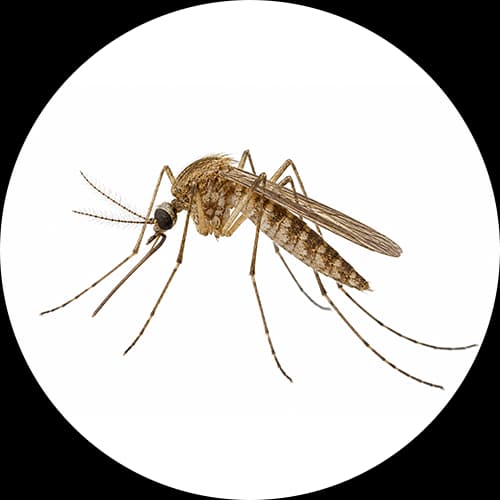
Anopheles Mosquito (Genus: Anopheles)
Anopheles mosquitoes are a globally important group of mosquitoes best known as the primary vectors of malaria. More than 400 species of Anopheles mosquitoes exist worldwide, but only a limited number are capable of transmitting malaria parasites to humans.
Unlike many other mosquito species, Anopheles mosquitoes have unique resting behavior, breeding preferences, and biological characteristics that help distinguish them from Aedes and Culex mosquitoes. They typically breed in clean freshwater habitats and are most active during the evening, night, and early morning hours.
Female Anopheles mosquitoes require blood meals for egg development and can transmit malaria-causing parasites (Plasmodium species) during feeding.
Identification
Anopheles (Diptera: Culicidae)
Resting Position (45° Angle)
The most distinctive feature of Anopheles mosquitoes:
This differs from:
• Culex: Body remains parallel to the surface
• Aedes: Body usually angled downward
Mouthparts
Female
Long piercing-sucking proboscis. Feeds on blood for egg production.
Male
Feeds only on plant nectar. Does not bite humans.
Important Pest Species
Life Cycle
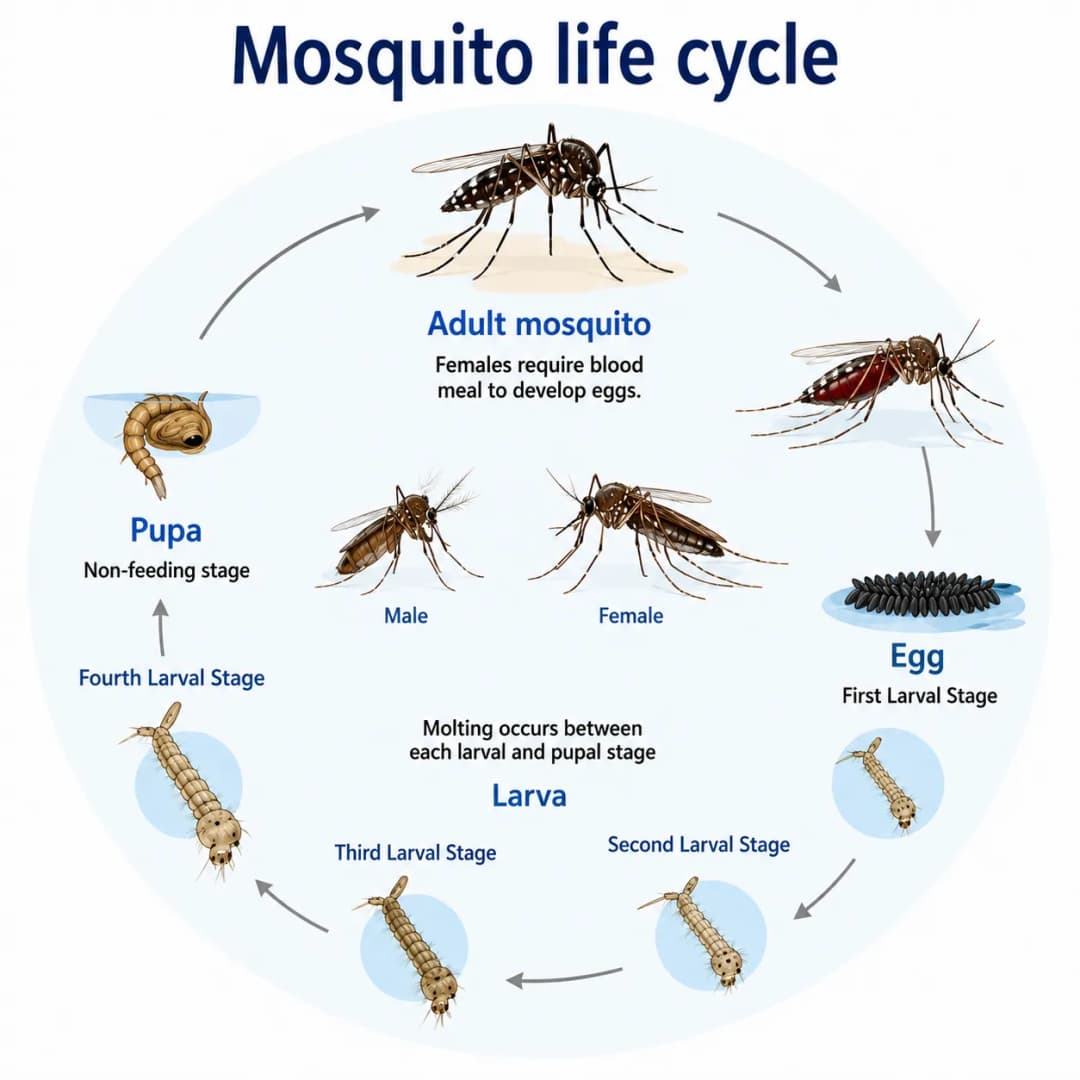
Anopheles mosquitoes undergo complete metamorphosis with four life stages:
Egg Stage (with Lateral Floats)
Common egg-laying habitats include:
Eggs usually hatch within: 2–5 days, depending on temperature
Larva Stage (Parallel to Surface)
Feeds on:
Algae, Microorganisms, Organic particles
Larval development usually takes: 7–14 days depending on temperature, food availability, and water conditions.
Pupa Stage
Pupal stage lasts: Approximately 2–4 days
Adult Stage
Adult lifespan: Typically 2–4 weeks (some females survive longer under favorable conditions)
Reproduction
Anopheles mosquitoes reproduce through mating flights.
Lateral Floating Eggs & Siphonless Larvae
Individual eggs with lateral floats hatch in 2–5 days. Larvae lie parallel to the water surface without breathing tubes, utilizing abdominal spiracles.
Anopheles mosquitoes prefer clean freshwater breeding habitats like rice fields, irrigation canals, and slow streams.
Feeding Habits
Adult Males
Feed on:
They do not bite humans.
Adult Females
Require blood meals for egg development.
Preferred hosts include:
Feeding behavior:
• Mostly active from dusk to dawn
• Peak biting often occurs: Late night & Early morning hours
• Some species prefer indoor feeding (endophagic)
• Some prefer outdoor feeding (exophagic)
Behavior
Mostly active during nighttime
Weak to moderate flyers
Rest indoors and outdoors depending on species
Females locate hosts before feeding
Some species rest indoors after feeding
Attracted to:
Common resting locations:
Habitat
Anopheles mosquitoes generally prefer clean freshwater breeding habitats.
Common breeding sites include:
Different species have specific habitat preferences:
• Anopheles stephensi: Can breed in urban water containers and construction sites.
• Anopheles culicifacies: Commonly breeds in rural agricultural areas.
Signs of Anopheles Mosquito Activity
Common indicators include:
Nighttime mosquito bites
Increased mosquito activity near freshwater breeding sites
Mosquitoes resting on walls with angled body posture
Larvae in ponds, irrigation channels, or water collections
Increased mosquito populations during rainy seasons
Health Risks
Anopheles mosquitoes are medically important because they transmit malaria parasites.
Malaria (Plasmodium)
Caused by:
Malaria Symptoms
Symptoms may include:
Severe Malaria
Severe malaria may cause:
• Organ complications
• Severe anemia
• Neurological problems
• Death if untreated
Other Health Impacts (Mosquito bites may also cause):
Favorable Conditions
Anopheles mosquitoes thrive in:
Population increases occur during:
Seasonal Activity
Anopheles mosquito populations vary depending on climate and species.
Peak activity generally occurs during:
In tropical regions, transmission risk may continue throughout the year.
Why Anopheles Mosquitoes Are Difficult to Control
Anopheles mosquitoes are challenging pests because they:
Effective control requires an integrated approach combining:
• Breeding-site management
• Insecticide-treated nets
• Indoor residual spraying
• Surveillance
• Community awareness
Distribution
Anopheles mosquitoes are found worldwide except Antarctica. They are most common in:
Major malaria-endemic regions include:
Comparison: Anopheles vs. Aedes vs. Culex Mosquitoes
| Feature | Anopheles Mosquito | Aedes Mosquito | Culex Mosquito |
|---|---|---|---|
| Common Name | Malaria mosquito | Dengue mosquito | House mosquito |
| Biting Time | Night | Daytime | Night |
| Resting Position | Body angled upward | Body angled downward | Body parallel |
| Egg Type | Individual floating eggs | Individual eggs on container surfaces | Egg rafts |
| Breeding Sites | Freshwater habitats | Small water containers | Polluted stagnant water |
| Main Diseases | Malaria | Dengue, chikungunya, Zika | Japanese encephalitis, West Nile, filariasis |
Common Pest Species
| Common Name | Scientific Name | Distribution |
|---|---|---|
| Asian Malaria Mosquito | Anopheles stephensi | South Asia, Middle East |
| Indian Malaria Mosquito | Anopheles culicifacies | Indian subcontinent |
| African Malaria Mosquito | Anopheles gambiae complex | Sub-Saharan Africa |
| African Vector Mosquito | Anopheles funestus | Africa |
| New World Malaria Mosquito | Anopheles darlingi | Central and South America |
Quick Facts
| Feature | Details |
|---|---|
| Common Name | Anopheles Mosquito / Malaria Mosquito |
| Scientific Genus | Anopheles |
| Order | Diptera |
| Family | Culicidae |
| Diet | Plant nectar (males), blood meals (females) |
| Breeding Sites | Freshwater pools, ponds, rice fields, irrigation channels |
| Development | Egg → Larva → Pupa → Adult |
| Egg Type | Individual eggs with floats |
| Peak Activity | Dusk to dawn |
| Main Health Risk | Malaria transmission |
| Major Control Method | Source reduction, bed nets, insecticide-based control |
Prevention
Source Reduction
Control breeding habitats by:
Personal Protection
Environmental Management
Specialized Malaria Vector Management
Get in touch for specialized anti-larval treatments, indoor residual spraying (IRS), and perimeter misting to eliminate malaria-transmitting Anopheles mosquitoes.
Protect Your Property from Anopheles Mosquitoes
Professional, safe, and effective pest management solutions for homes and businesses.