Asian Tiger Mosquito
(Aedes albopictus) (Diptera: Culicidae)
The Asian tiger mosquito is an aggressive daytime biter recognizable by its black body, white banded legs, and single central dorsal white stripe. It breeds in artificial containers and transmits Dengue, Chikungunya, and Zika. Learn about its biology, disease risks, and source reduction.
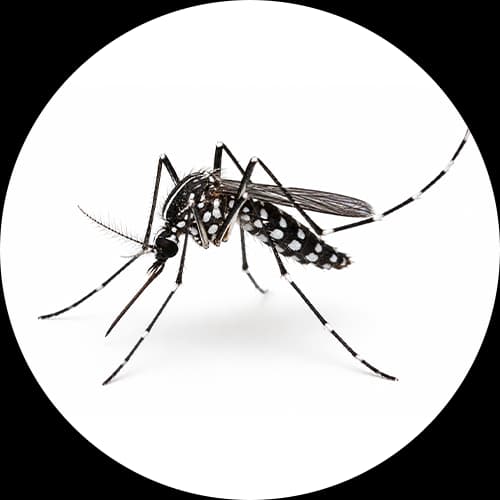
Asian Tiger Mosquito (Aedes albopictus)
The Asian tiger mosquito (Aedes albopictus) is a small, aggressive, day-biting mosquito species belonging to the family Culicidae. It is recognized by its distinctive black-and-white striped body and legs, giving it the common name "tiger mosquito."
Originally native to Southeast Asia, this mosquito has spread globally and is now established in many tropical, subtropical, and temperate regions. It is considered an important pest because of its biting nuisance, rapid adaptation to urban environments, and ability to transmit several mosquito-borne diseases.
Asian tiger mosquitoes commonly breed in small artificial water containers and are frequently associated with residential areas, gardens, construction sites, and urban landscapes.
Identification
Aedes albopictus (Diptera: Culicidae)
Key Identification Features
Life Cycle
Asian tiger mosquitoes undergo complete metamorphosis: Egg → Larva → Pupa → Adult.
The life cycle can be completed in approximately 1–3 weeks depending on temperature, food availability, and environmental conditions.
Desiccation-Resistant Container Eggs
Common egg-laying sites:
Eggs hatch when: Water levels rise, Rainfall floods the egg-laying site
Aquatic Microorganism Feeders
Common larval habitats:
Larval development: Approximately several days to weeks
Non-Feeding Metamorphic Tumbler
Pupal duration: Usually a few days
Aggressive Daytime Biters & Flyers
Adult lifespan:
Usually several weeks depending on environmental conditions
Reproduction
Asian tiger mosquitoes reproduce rapidly when breeding sites are available.
Reproductive Characteristics:
Population growth is encouraged by:
Feeding Habits
Male Mosquitoes
Male mosquitoes feed mainly on:
They do not bite humans.
Female Mosquitoes
Females feed on:
• Plant nectar for energy
• Blood meals for egg development
Common hosts:
Behavior
Asian tiger mosquitoes are aggressive daytime biters.
Activity Pattern:
• Peak activity: Early morning
• Peak activity: Late afternoon
• They may also bite throughout daylight hours
Flight and Movement (Characteristics):
• Short-distance flyers
• Prefer shaded areas
• Rest close to breeding sites
Host-Seeking Behavior (Females locate hosts using):
Habitat & Breeding Sites
Asian tiger mosquitoes are highly adapted to urban environments.
Residential Areas
Common locations:
Commercial Areas
Frequently found in:
Natural Habitats
Breeding may occur in:
Common Breeding Sites
Asian tiger mosquitoes prefer small collections of stagnant water. Examples:
Signs of Asian Tiger Mosquito Activity
Mosquito Sightings
Indicators include:
• Small black-and-white mosquitoes
• Daytime biting activity
• Mosquitoes resting near vegetation
Breeding Evidence
Signs include:
• Standing water containers
• Mosquito larvae in stagnant water
• Egg presence on container surfaces
Biting Complaints
Common reports:
• Daytime mosquito bites
• Outdoor biting nuisance
• Increased mosquito activity after rainfall
Damage and Nuisance Caused
Biting Nuisance
Female mosquitoes cause:
Outdoor Activity Problems
They affect:
• Gardens
• Recreational areas
• Outdoor dining spaces
• Residential communities
Commercial Impact
Asian tiger mosquitoes may affect:
Hotels, Resorts, Restaurants, Schools, Housing complexes
Concerns include:
• Guest complaints
• Reduced outdoor usability
• Public health concerns
Health Risks
Asian tiger mosquitoes are medically important because they can transmit several pathogens.
Dengue Fever
Associated with: Dengue viruses
Symptoms may include:
Chikungunya
Associated with: Chikungunya virus
Common symptoms:
• Fever
• Joint pain
• Fatigue
Zika Virus
Associated with: Zika virus
May cause:
• Mild fever
• Rash
• Joint discomfort
Other Pathogens: Depending on geographic region, Asian tiger mosquitoes may be involved in transmission of other mosquito-borne diseases.
Favorable Conditions
Asian tiger mosquitoes thrive in:
Common contributing factors:
Seasonal Activity
Activity increases during:
In tropical climates, populations may remain active throughout the year.
Control and Management
Effective mosquito management requires an Integrated Pest Management (IPM) approach.
1. Inspection
Identify:
• Breeding sites
• Water-holding containers
• Adult mosquito resting areas
2. Source Reduction
Primary control method:
• Eliminate breeding habitats
• Remove stagnant water
3. Larval Control
Methods include:
• Biological larvicides
• Water management
• Treatment of unavoidable breeding sites
4. Adult Mosquito Control
Methods include:
• Targeted adult mosquito treatments
• Resting-site treatments
• Vegetation management
5. Monitoring
Methods include:
• Larval surveys
• Adult mosquito monitoring
• Breeding-site inspections
Why Asian Tiger Mosquitoes Are Difficult to Control
They are challenging because they:
Distribution
Asian tiger mosquitoes are distributed across:
They are especially common in:
Tropical areas, Subtropical climates, Urban environments
Comparison: Asian Tiger Mosquito vs. Aedes aegypti
| Feature | Asian Tiger Mosquito | Aedes aegypti |
|---|---|---|
| Scientific Name | Aedes albopictus | Aedes aegypti |
| Appearance | Black body with white stripe | Black body with lyre-shaped markings |
| Biting Time | Mainly daytime | Mainly daytime |
| Habitat | Urban and peri-urban | Mostly urban |
| Breeding | Small water containers | Small water containers |
Comparison: Asian Tiger Mosquito vs. Culex Mosquito
| Feature | Asian Tiger Mosquito | Culex Mosquito |
|---|---|---|
| Activity | Day biting | Mostly evening/night biting |
| Appearance | Black-white striped | Brownish mosquito |
| Breeding | Small containers | Larger stagnant water bodies |
| Main Concern | Dengue, chikungunya, Zika | West Nile and other diseases |
Common Mosquito Species
| Common Name | Characteristics |
|---|---|
| Asian Tiger Mosquito | Day-biting striped mosquito |
| Aedes Mosquito | Dengue and chikungunya vector |
| Culex Mosquito | Common urban mosquito |
| Anopheles Mosquito | Malaria vector |
Quick Facts
| Feature | Details |
|---|---|
| Common Name | Asian Tiger Mosquito |
| Scientific Name | Aedes albopictus |
| Family | Culicidae |
| Order | Diptera |
| Size | 2–10 mm |
| Development | Egg → Larva → Pupa → Adult |
| Breeding Sites | Small stagnant water containers |
| Activity | Mainly daytime |
| Main Concern | Biting nuisance and disease transmission |
| Control Approach | Source reduction and IPM |
Prevention
Source Reduction
Most effective method:
Water Management
Property Maintenance
Personal Protection
Comprehensive Day-Biting Mosquito & Vector Control
Stop day-biting tiger mosquitoes around gardens, patios, and construction sites with targeted container source reduction, biological Bti larviciding, and barrier misting.
Protect Your Family from Asian Tiger Mosquitoes
Professional, safe, and effective mosquito larviciding and adult control solutions for homes, resorts, and commercial properties.