House Fly
(Musca domestica)
The house fly is a major public health and sanitation pest mechanically transmitting Salmonella, E. coli, and foodborne pathogens via sponging mouthparts and regurgitation. Learn about its identification, 7–10 day life cycle, feeding habits, fly comparison, and prevention.
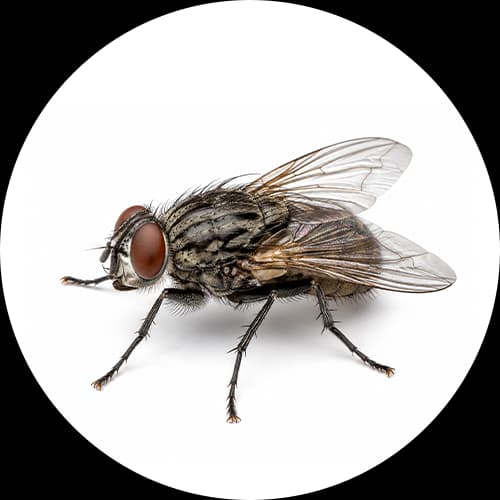
House Fly (Musca domestica)
The house fly is one of the most common and widely distributed insect pests affecting human environments. It is closely associated with human settlements, livestock facilities, food establishments, waste disposal areas, and agricultural operations.
House flies are considered important public health pests because they can mechanically transfer disease-causing organisms from contaminated materials such as garbage, animal waste, sewage, and decaying matter onto food, utensils, and surfaces.
They are highly adaptable, reproduce rapidly, and can complete their life cycle in a short period under warm and humid conditions. Effective house fly management requires an integrated approach involving sanitation, exclusion, breeding-site elimination, and population monitoring.
Identification
Musca domestica (Diptera: Muscidae)
Key Identification Features
Life Cycle
House flies undergo complete metamorphosis with four distinct stages: Egg → Larva (Maggot) → Pupa → Adult.
The complete life cycle can be completed in as little as 7–10 days under favorable conditions.
Moist Organic Matter
Common egg-laying sites:
Eggs hatch within: 8–24 hours depending on temperature and moisture
Creamy-White Maggots
Common larval habitats:
Dark Brown Puparium
Emergence & Feeding
Adult lifespan:
Approximately 15–30 days (May survive longer under favorable conditions)
Reproduction
House flies have extremely high reproductive potential.
Reproductive Characteristics:
Population growth is fastest when:
Feeding Habits
House flies have sponging mouthparts and cannot consume solid food directly. They feed by:
Common Food Sources:
Behavior
House flies are highly active and adaptable insects. Characteristics:
Mostly active during daylight hours
Strong flyers
Rest frequently between feeding periods
Attracted to odors from food and waste
Prefer warm, sunny conditions
Common Resting Areas
Indoor:
• Walls
• Ceilings
• Light fixtures
• Windows
• Food preparation areas
Outdoor:
• Fences
• Garbage containers
• Vegetation
• Animal shelters
• Building walls
Habitat
House flies are closely associated with areas containing organic waste. Common habitats include:
Residential Areas
Commercial Areas
Agricultural Areas
Signs of House Fly Activity
Common indicators include:
Adult Fly Presence
• Frequent fly sightings
• Flies resting on walls and ceilings
• Increased activity around food areas
Maggot Activity
Larvae may be found in:
• Garbage bins
• Compost
• Manure piles
• Organic waste
Fly Spots
Small dark marks caused by:
• Fecal deposits
• Regurgitated food material
Common locations:
Walls, Windows, Ceilings, Light fixtures
Breeding Site Indicators
• Strong odors
• Accumulated organic waste
• Moist garbage areas
• Animal manure buildup
Damage and Nuisance Caused
Food Contamination
House flies contaminate food through:
They can transfer microorganisms onto:
• Food products
• Utensils
• Preparation surfaces
Business Impact
House flies can affect:
Restaurants, Food manufacturing facilities, Hospitality businesses, Healthcare facilities
Problems include:
• Customer complaints
• Hygiene concerns
• Regulatory issues
• Brand reputation damage
Health Risks
House flies are important mechanical disease vectors. They can carry pathogens including:
Bacterial Diseases
Potentially associated organisms include:
• Salmonella
• E. coli
• Shigella
• Staphylococcus
Foodborne Illness
Transmission may occur when flies move between:
• Waste materials
• Animal feces
• Food preparation areas
Parasites
Flies may transport:
• Worm eggs
• Protozoan organisms
• Other contaminants
Favorable Conditions
House flies thrive in:
Population growth increases rapidly during:
Seasonal Activity
House fly activity is strongly influenced by temperature.
Peak activity:
In tropical climates, breeding may continue throughout the year.
Control and Management
Effective house fly control requires an Integrated Pest Management (IPM) approach.
1. Inspection
Identify:
• Breeding sources
• Entry points
• Resting areas
• Food attractants
2. Source Reduction
Remove:
• Organic waste
• Manure accumulation
• Decaying materials
• Standing contaminated water
3. Monitoring
Methods include:
• Fly traps
• Sticky monitoring cards
• Visual inspections
• Population tracking
4. Targeted Control
May include:
• Larval control
• Adult fly management
• Residual treatments
• Mechanical traps
Why House Flies Are Difficult to Control
House flies are challenging pests because they:
Distribution
House flies are found worldwide except in extremely cold regions.
They occur in:
They are among the most widely distributed insect pests globally.
Comparison: House Fly vs. Fruit Fly vs. Blow Fly
| Feature | House Fly | Fruit Fly | Blow Fly |
|---|---|---|---|
| Scientific Name | Musca domestica | Drosophila spp. | Calliphoridae family |
| Size | 6–7 mm | 2–4 mm | 8–14 mm |
| Breeding Material | Garbage, manure, waste | Fermenting fruits and liquids | Dead animals, meat waste |
| Flight | Strong flyer | Short flights | Strong flyer |
| Main Concern | Disease contamination | Food nuisance | Decomposition-related contamination |
Common Fly Species Around Buildings
| Common Name | Scientific Name | Characteristics |
|---|---|---|
| House Fly | Musca domestica | Major sanitation pest |
| Fruit Fly | Drosophila spp. | Breeds in fermenting materials |
| Blow Fly | Calliphoridae spp. | Associated with meat and carcasses |
| Drain Fly | Psychodidae spp. | Breeds in organic drain deposits |
Quick Facts
| Feature | Details |
|---|---|
| Common Name | House Fly |
| Scientific Name | Musca domestica |
| Order | Diptera |
| Family | Muscidae |
| Diet | Liquids, organic matter, food waste |
| Activity | Mainly daytime |
| Breeding Sites | Garbage, manure, decaying organic matter |
| Development | Egg → Larva → Pupa → Adult |
| Egg Production | 500–1,000 eggs per female |
| Life Cycle | 7–10 days under favorable conditions |
| Lifespan | 15–30 days |
| Major Risk | Food contamination and disease transmission |
Prevention
Sanitation Management
The most important control method:
Structural Prevention
Environmental Management
Commercial Fly & Sanitation Management
Ensure food safety compliance with UV fly light traps, drain treatments, air curtains, and breeding site reduction.
Protect Your Property from House Flies
Professional, safe, and effective pest management solutions for homes and businesses.